
Reviewed by the Armrock Constructions team — 450+ bathroom renovations completed across the Gold Coast
Quick answer: Round mirrors soften the hard lines of tiles, vanities and shower screens, and they suit both small and large bathrooms. As a guide, choose a diameter of about two-thirds to three-quarters of your vanity width and centre it at roughly 1500–1600 mm above the floor. Backlit LED versions are a great option, but must be wired by a licensed electrician.
Rectangular mirrors have been the default in Australian bathrooms for decades. Round mirrors are now a regular feature in modern bathroom design, and for good reason: they change how a room feels without changing the layout. This guide explains why they work, how to size and position them, and what to plan before the tiler arrives in your bathroom renovation Gold Coast project.
Why round mirrors suit modern bathroom design
Contemporary bathroom design is built on straight lines: large-format tiles, rectangular vanities, framed shower screens and linear drains. A round mirror is the one curved element in that grid. It gives the eye a focal point above the basin and breaks up repetition without adding clutter, which is why it pairs so well with minimalist bathroom design and modern bathroom style.
Round mirrors also work with almost any finish. Because the shape is simple, the frame (or frameless edge) doesn’t compete with matte black bathroom fittings, brushed nickel bathroom fittings or brushed brass tapware.
How round mirrors soften a hard-edged bathroom
Few rooms have more right angles than a bathroom. Walls, floor tiles, benchtops, cabinetry and glass all meet at 90 degrees, and a circle is the one shape on the wall that doesn’t.
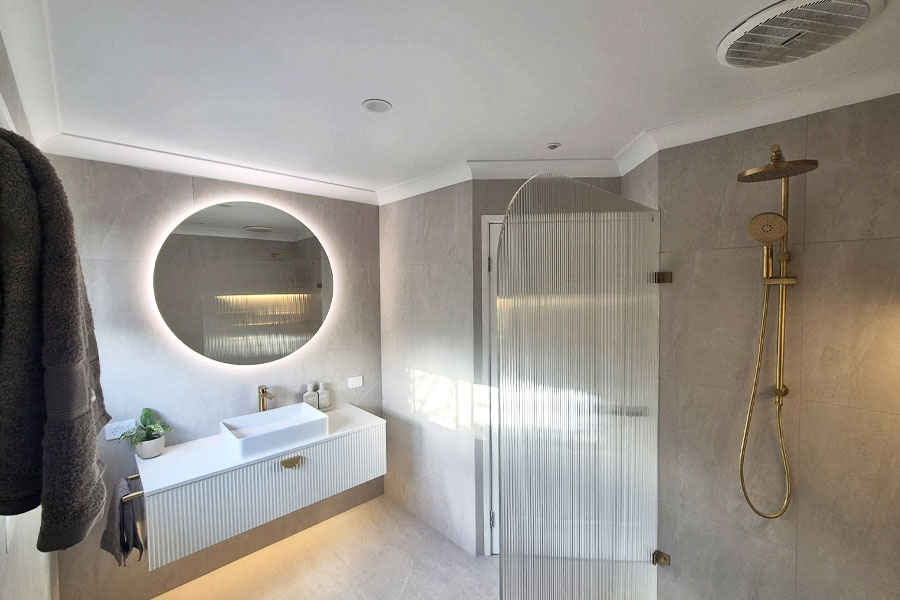
In a bathrooms, a round mirror can give the eye somewhere calm to rest. In a plain tiled bathroom, it adds shape without adding colour. A curved mirror also echoes other curves in the room, such as a round basin, an oval bath or an arched shower screen.
Round mirrors in small bathrooms and ensuites
In a compact room, the mirror is often the largest visible surface. A round mirror 600–800 mm in diameter fits above a single vanity without crowding the wall, and leaves space on either side for a wall light or towel rail. Placed opposite a window or light source, it reflects light across the room and makes the space feel larger.
This is why round mirrors feature in so many small bathroom renovations on the Gold Coast, including ensuites and apartments where every 100 mm of wall counts. A mirror with integrated lighting can also replace separate wall lights, which can reduce the number of electrical points needed.
Backlit round mirrors: what to check before you buy
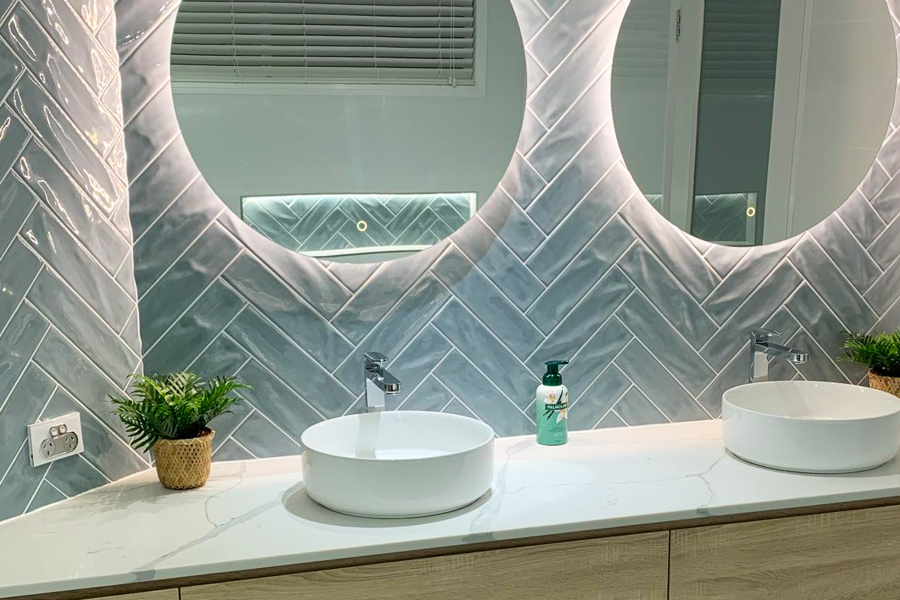
A backlit round mirror has an LED strip behind the edge of the glass that casts a soft glow onto the wall. It gives even, low-glare light for grooming and doubles as night lighting. Before you choose one, check the following:
- IP rating: Choose a mirror rated for bathroom use, commonly IP44 or higher, and confirm it against the manufacturer’s specification.
- Colour temperature: 3000K gives a warm white and 4000K a neutral white. Many mirrors let you switch between the two.
- Colour rendering: A colour rendering index (CRI) of 90 or above shows skin tones accurately.
- Demister pad: A heated pad behind the glass stops fogging after a hot shower.
- Wiring: Fixed wiring must comply with AS/NZS 3000, and in Queensland it must be done by a licensed electrician.
Our electrical service coordinates this work as part of the renovation, so the cable and connection point are in the right place before the walls are lined and tiled.
Choosing the right size and height
Most mirror problems come from size and height rather than style. These are common guides, which you can adjust for your household:
- Diameter: Aim for about two-thirds to three-quarters of the vanity width. That is roughly 500–600 mm for a 750 mm vanity, 600–700 mm for a 900 mm vanity and 800–900 mm for a 1200 mm vanity.
- Centre height: Position the centre at about 1500–1600 mm above the finished floor, then adjust for the tallest regular user.
- Bottom edge: Keep the lowest point about 150–200 mm above the vanity top or splashback, so the tapware doesn’t crowd the glass.
- Double vanities: Use two round mirrors, one centred over each basin. Our guide to the advantage of two basins covers layout in more detail.
Matching your mirror with the vanity, tapware and tiles
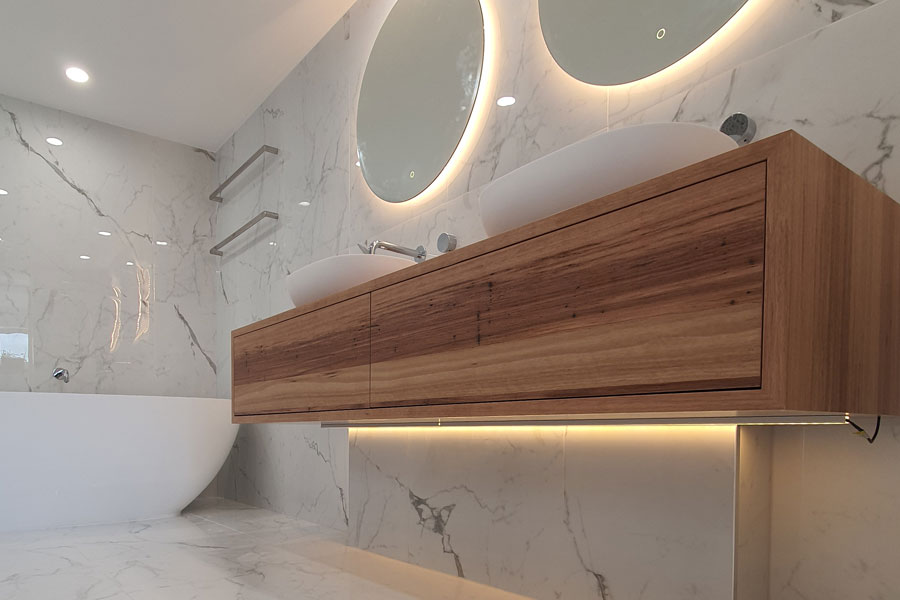
The mirror should relate to what sits beneath it. A floating vanity bathroom layout paired with a round mirror keeps the whole wall light, because both appear to float off the surface. Our article on freestanding vs floating vanities explains the differences in space, cleaning and storage.
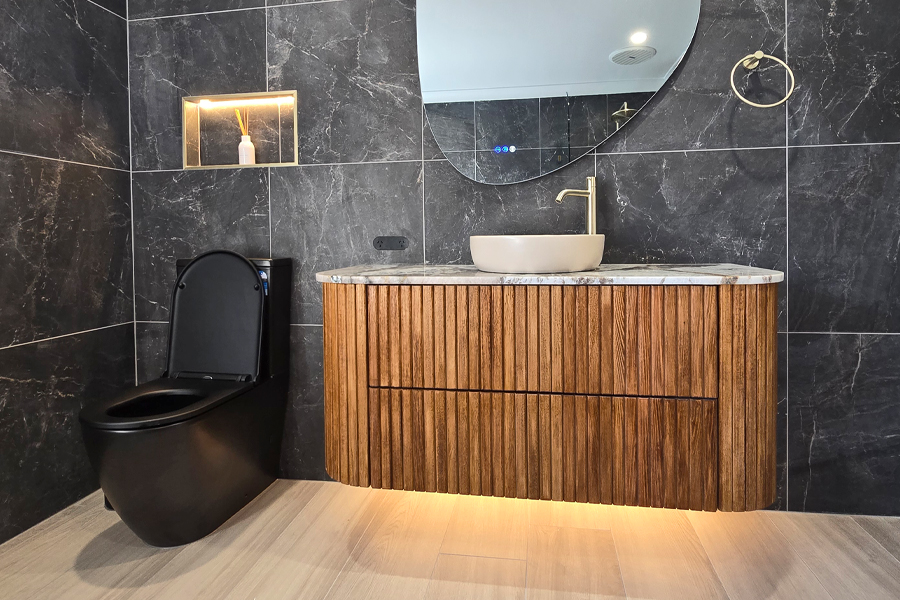
Curves also contrast well with vertical lines. Fluted or timber-look vanity fronts look sharper under a round mirror, and a round mirror suits a simple rectangular basin better than a heavily detailed one. Keep to two metal finishes at most, and match the mirror frame to your tapware and accessories so they read as one set. If you want a vanity designed around the mirror, browse our bathroom vanities and custom options.
Planning a round mirror into your renovation
A round mirror is easiest to include in the plan before the walls are lined. In a typical renovation, the order is framing, electrical rough-in, waterproofing to AS 3740, tiling and fit-off. Decisions about the mirror need to happen at the start of that sequence:
- Backing: Add solid timber blocking behind the wall lining so the mirror can be fixed securely.
- Power: Run the cable and position the connection point at framing stage, before waterproofing and tiling.
- Switching: Decide whether the mirror gets its own switch or a sensor.
- Tile layout: Centre the mirror on the basin and tap, and set the tile courses so the edges don’t land on awkward cuts.
You can see how these details come together in our bathroom renovation gallery.
Frequently asked questions
Yes. A round mirror 600–800 mm in diameter fits above a single vanity without crowding the wall, and its curved edge makes the room feel less boxed in. Placed opposite a window, it also reflects natural light across the space.
Choose a diameter of about two-thirds to three-quarters of the vanity width. For example, a 900 mm vanity suits a 600–700 mm mirror. For a double vanity, use two mirrors, one over each basin.
Centre it at about 1500–1600 mm above the floor, and keep the bottom edge 150–200 mm above the vanity top or splashback. Adjust the height if the main users are notably taller or shorter.
Yes. Fixed wiring in a bathroom must comply with AS/NZS 3000, and in Queensland it must be installed by a licensed electrician. It is easiest to run the cable at framing stage, before waterproofing and tiling.
A standard round mirror can be fixed to an existing wall, provided the wall has suitable backing. A backlit mirror needs a power connection, so you will need an electrician to install one if there isn’t already a suitable point.
Planning bathroom renovations on the Gold Coast?
Armrock Constructions has completed 450+ bathroom renovations and manages plumbing, electrical, waterproofing, tiling, carpentry and finishing through one team. Explore our bathroom renovation Gold Coast services, or book a free appraisal and quote to talk through your design.