• Skip to primary navigation
  • Skip to main content
  • Skip to primary sidebar
  • Skip to footer
Armrock Constructions

Armrock Constructions

Gold Coast Bathroom Renovations

  • Bathroom Renovations
    • Projects
    • Vanities
    • Gallery
    • Tiling
    • Fixtures and Fittings
      • Vanities
      • Splashbacks
      • Lighting
      • Showers
      • Drains
      • Toilet
      • Tapware
    • FAQ
  • About Us
    • Service Area
    • Project Management
  • Services
    • Builder
    • Carpentry
    • Plumbing
    • Electrical
    • Cabinetry
    • Shower Screens
    • Tiling
    • Painting
    • Plastering
  • Projects
  • Gallery
  • Testimonials
  • Renovation Design Ideas
  • Contact Us
Book a Free Renovation Appraisal | 0417 490 938

Renovation Design

Matte Vs Glossy Bathroom Sink

When it’s time to select a bathroom sink in your bathroom design, an important question arises: Should the sink finish be matte or glossy? Armrock Constructions specialises in bathroom renovations on the Gold Coast QLD, and we have used both matte and glossy sinks in a number of projects. In this article, we examine the benefits of both approaches, and hope to provide some insight to help with making a decision for your own bathroom design. If you’re considering a renovation on the Gold Coast, please contact our team – we provide a free consultation and quote, and look forward to assisting you.

Book a Free Renovation Consultation & Quote

Understanding the role of the Bathroom Sink

Once upon a time, bathroom sinks were not as glamorous as they are today. They were a purely functional bathroom inclusion – a necessity to capture water and enable washing. While we’re still spitting our toothpaste into them, their role has evolved. They now play a vital part in the presentation of the room. This is accomplished via these two main avenues:

  1. Presence: The bathroom sink may have more or less presence by the way it is mounted in the vanity unit. A fully recessed sink has a lower presence than a sink mounted above the vanity unit.
  2. Finish: The finish of the sink is the other important factor. The colour and texture of the sink, as the centrepiece of the vanity, which is the centrepiece of the whole bathroom, are extremely important from an aesthetic point of view.

From a functional perspective, both matte and gloss sinks perform in a similar way. There are minor differences, but they’ll both make your toothpaste disappear. However, in terms of aesthetics the outcomes are different. In this article, we examine the difference between matte and gloss sinks, and how they can be optimally applied to achieve specific design goals for your bathroom.

The Different Between Matte & Gloss Sinks

Matte and gloss are different finishes. They convey a different look and have different textures. Here is the breakdown:

Matte: Less reflective, more texture, diffuse impression
Gloss: More reflective, smoother, shiny impression

The key difference in comparing these finishes relates to their interaction with light. Because the different finishes absorb (matte) and reflect (gloss) light to different degrees, they can be judiciously added to a bathroom to create different relationships, references and continuities in a bathroom renovation design.

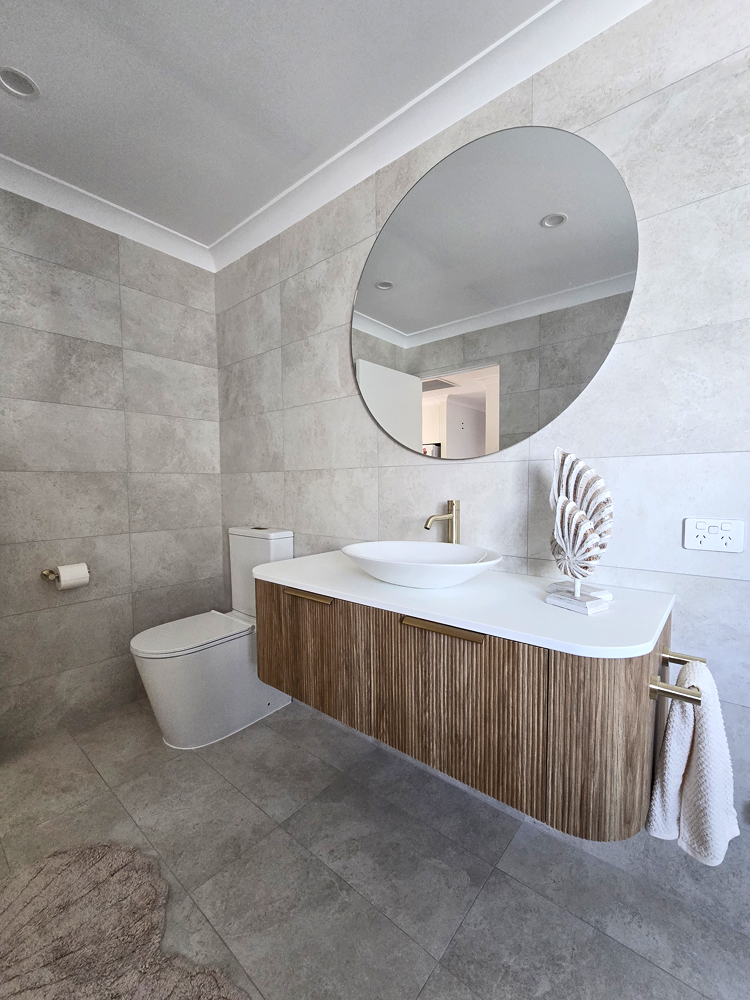
Here are a couple of pics from recent Armrock Gold Coast bathroom renovations to demonstrate the difference of matte and gloss sinks in action:

Gloss Bathroom Sinks – Armrock Constructions
Matte Bathroom Sink – Armrock Constructions

As you can see, depending on the amount of light in the room, they both have a degree of reflection; however, the matte finish creates a more diffuse & less shiny result. You can learn more about using matte and gloss in interior design in this article

Why Does it Matter?

I could tell you that everything matters in a bathroom renovation, but hopefully you already know that! Here’s a thought. In a bathroom, the centrepiece of the room is the bathroom vanity – it’s the key expression of the bathroom. And what sits on top of that, like a trophy on a table?

Especially in a bench-mounted format (as opposed to an inset basin), the sink becomes a signature aspect of the signature part of the bathroom design. Accordingly, it is certainly worth getting the right type of sink in place to achieve an optimal result.

How Colour Fits in

Matte and Gloss finishes can be applied to create different effects from the same colour. These finishes are colour-independent. For example, you could have a white basin with a matte finish, or a white basin with a gloss finish. Either way, it would still be white – but the finish would create a slightly different expression of the colour. There is virtually no limitation to bathroom sink colours, although mainstream design trends usually see them being available in common colours such as white, black, grey, and beige.

Matte White Sink with Timber Laminate Benchtop

Simplifying Colour

The unlimited options in interior design are liberating, but a degree of restraint is usually part of the recipe for success. The more colours you introduce to a design, the more challenging it can be to reconcile the design. Here’s where a major advantage of matte and gloss finishes becomes apparent. They provide a non-colour method of approaching diversity in bathroom design – creating subtle relationships and references that don’t take you away from your design goals. For example, if you would like to introduce a degree of contrast with your bathroom sink, it can be accomplished with a different finish, rather than a different colour.

The Natural Connection

Underpinning many modern bathroom designs is the goal to make a natural connection. In natural water environments, there is usually a combination of matte and gloss, and often relationships interchange as well. Think of river rocks, and the way they might dry out to a matte finish, only to sparkle to life when water is introduced. In these environments, everything is neither shiny nor dull – there is an interplay, and combining matte and gloss textures in a bathroom design is an extension of this naturalistic tendency.

Following are some examples of gloss an matte sinks in action in different combinations for different outcomes:

Working with Timber

Timber is a popular, enduring material for bathroom vanity design, both in benchtops and cabinetry. The relevance being that the sink appears closest to these aspects, particularly the benchtop, making that relationship very important. In the following image, which is from an Armrock renovation on the Gold Coast, you can see the gloss white sinks create a high degree of contrast with the warm, tactile timber tones.

Double Gloss Sinks with Timber-Look Laminate Vanity

In the next example, the matte sink is very similar to the vanity unit – is shares a textural and tonal relationship. Both of these outcomes are fantastic, but they feel very different. The first example is bolder, brighter, more forthright and engaging; the second example is more natural, subtle, less overtly visually engaging and somewhat understated. There is no right or wrong – it just depends on what type of bathroom is best for your home and family.

Single Matte Sink with Timber-Look Laminate Vanity

Working with Stone

In a similar way to timber, the relationships between matte and gloss bathroom sinks and their stone (or stone-look) benchtops is defined by contrasts in texture, tone, and reflection. In the following Gold Coast penthouse renovation, we have paired glossy white sinks with a black stone-look laminate benchtop with a highly reflective finish. The dual reflective finishes and high-contrast colours create a striking, sophisticated and strong impression.

Gold Coast Penthouse Renovation

Meanwhile, (and, appreciating that these are two different bathroom renovations and not directly comparable) in the following image we paired a pastel, matte raised sink with a stone-look benchtop for a completely different effect. Irrespective of colours and styles, using a matte finish in the basin generally creates a reduced, softer impression that their glossy counterparts.

Pastel Matte Bathroom Sink with Stone-Look Benchtop

We hope some of the ideas in this article have been useful for you as you approach planning your bathroom renovation, and coming to terms with matte and gloss options for your bathroom sink. If you’re on the Gold Coast, please don’t hesitate to contact our team. We look forward to helping with your bathroom renovation.

Book a Free Renovation Consultation & Quote

Filed Under: Renovation Design Tagged With: Basin, Bathroom Design, Gloss, Matte, Matte Vs Gloss Bathroom Sink, Sink

What Colour Blinds Go With White Walls?

Interior blinds with white walls

What colour blinds go with white walls? When you’re choosing blinds for a room with white walls, does everything work equally well? They’re important questions and well worth asking, especially when you consider that the walls of most homes and businesses are white or a similar tone, and this is especially true for bathrooms, where white and light tones are always a favourite.

Get some insight into selecting the best blinds for your white walls with some help from the design team at Armrock Constructions, on the Gold Coast QLD. Enjoy! 

Book a Free Renovation Consultation & Quote

What Colour Blinds Go With White Walls – The Easy Answer

The easy and short answer to this question is “all colours”. Why? White is a neutral colour, so when you partner it up with any other colour, they just go along together nicely. It doesn’t matter what the colour is, or whether it’s light, dark, strong, vibrant, or has a pattern. They will work! Whatever you put with white will just go well. Whew!

What matters though, is that different effects can be created by partnering your white walls with different types of blinds. 

Because our goal is to find the best blinds for your white-walled rooms, in this article we will explore the way these effects can be created, hopefully giving you some tools to make better decisions when evaluating window-dressings for your home or business.

Bathroom Blinds with White Walls

Why Are Walls White?

Well, have you ever wondered why? Walls could be any colour, so why are they (nearly-always) white? Sometimes it seems that white is almost a default colour for walls. Why is this the case?

Every approach to interior design has advantages and disadvantages. And interpretations are very subjective. It’s not that white walls are always the best option – but they are probably the easiest, for these significant reasons:

  1. White walls don’t date. Unlike stronger colours or heavy patterns and textures, white walls don’t go out of date.
  2. White walls are versatile. The room can easily be updated by rearranging fixtures and fittings like towels, pot-plants, and interior blinds.
  3. White creates space. And a light background creates an open, airy sensation which is not achievable when darker colours are used.
  4. White enables the usage of a wider range of colours. Darker colours limit the options that can be used alongside them.

With white walls, interiors are ready for a variety of design options with less limitations than other more advanced design solutions.

Overcoming the Challenge with White Backgrounds

The challenge lies in having too many options. White creates a blank canvas, which opens up endless possibilities—but that can be overwhelming. Unlike more defined wall colours, white doesn’t offer an obvious starting point, like a complementary colour, to guide your decisions. That’s why we often find ourselves wondering, “What actually works with white?”—even though almost everything could.

Because white is neutral, almost any style of blind—light or dark, plain or patterned—can work with it. But that flexibility can also lead to decision fatigue, especially when you’re unsure of the overall look you’re aiming for.

So, where to begin? A good approach is to first picture the kind of atmosphere or style you want for the whole room. Once you have that in mind, choosing blinds becomes less about what matches the white, and more about what enhances your vision.

What Blinds with White Walls – The Whole Impression

To get started, it’s useful to create an impression of the room as a whole. The way to approach this will depend on where you’re at with your renovation. If everything is going to change, then everything needs to be mapped out before any changes are made, to create a holistic design. However, if some things are already established and in place, then these ‘known’ features will affect the choices you subsequently make. Things to look at:

  1. What type of white are the walls? Are you whites warm, cool, or neutral? Are they matt or gloss? Do they have any texture?
  2. Do the walls have any texture?
  3. What are the other colours in the room?
  4. What is the theme of the bathroom?

It’s also important to extend beyond the bathroom to consider the relationship between the bathroom and the rest of the house. You can read more about this in Using Colour to Create a Holistic Bathroom.

Handy Links (External) 

  • 5 Ways to connect rooms with colour
  • Create a visual connection across rooms
  • Meaning of the colour white
  • Whites and Neutrals

Natural Light & Privacy Considerations

Bathrooms - Where Privacy Matters
Bathrooms – Where Privacy Matters

While evaluating the whole impression of the room, don’t forget to take into account natural light (through the day) and privacy considerations. After all, these are two of the main functional reasons for getting blinds in the first place. Natural light should always be used to your advantage when possible – what’s better than a bathroom flooded with beautiful sunlight? Depending on the aspects of your windows, privacy considerations are always important, especially with bedrooms, bathrooms, and toilets.

The Fad Hazard – a Design Tip
Bold, trendy colours can feel exciting and fresh—today. But what you love now might feel outdated in just a few weeks (or even days). Eye-catching choices often stand out because they’re different, but that novelty can wear off quickly. The great thing about blinds is that they let you experiment with style without making permanent structural changes. Still, it’s smart to choose designs that will stand the test of time. You don’t want to find yourself back at the blind store in a month, shopping for replacements because your once-cool choice lost its charm.

Types of Blinds for Your Bathroom

After coming to terms with the whole impression of the room, including the natural light and privacy considerations, it’s time to make sure you’re up to speed with the main options in interior blinds. There are fabric-based blinds (such as roller blinds, vertical blinds, panel glides and Verishades) and shutters, which are a solid mechanism for blocking out light and vision. All of these have different purposes, and all come in a wide variety of natural and artificial colours and styles. Key information:

  1. Fabric blinds come in different types of fabric, which determine how much light and vision comes through the blinds. Depending on the aspect of your bathroom windows in relation to your neighbours, you can find a compromise between blinds that allow natural light into the room, and blinds that ensure you have adequate privacy.
  2. The three main fabric types you need to be aware of are blockout (or blackout), light-filtering, and screen fabrics. These all transmit light in different ways. Blockout blinds block out all the light and vision, making them a useful choice when you’re dealing with direct light or privacy considerations. Light-filtering fabrics block out nearly-all light and vision, but they do permit some light to filter through. Screen blinds permit both light and vision through the blinds.
  3. With fabric blinds, you will choose a fabrics and a colour / style. Different combinations have different outcomes for the appearance and functionality of the blinds.
  4. Different types of blinds and shutters come in at different price points.
Timber Venetian Blinds

The Importance of Contrast

When it’s time to choose the best blinds for your white walls, contrast is an essential aspect to understand and utilise for making decisions. Contrast is how different two things are, and can be low, medium or high. For example:

  1. High Contrast: White walls with black blinds (very different)
  2. Medium Contrast: White walls with a mid-tone colour blind (somewhat different) 
  3. Low Contrast: White walls with a light colour, similar to white (similar) 

The more contrast you create, the more visual stronger your solution will be. To get an idea of contrast in different bathroom renovations, check out our gallery here.

Low Contrast Solutions

White on white! Alright! Not since the invention of (white) rice has anything been quite as white as white blinds in a white room. When you go with a low-contrast approach, you’re minimising the presence of the blinds, since they will be quite similar to the white walls. With this approach, the blinds don’t define the room. This is done by things like towels, pot-plants, and other bathroom features. The blinds are a continuation of the existing tones so they don’t have any significant visual impact. 

White on white concepts include: sterile; classical; minimal; calm; chic; masculine; feminine; corporate; medical; austere. However, with appropriate styling, white-on-white can be made to suit practically any requirement.  

After white-on-white blinds, you can look at combinations whereby the colour of the blinds is offset, but not by much, from the colour and tone of the walls. For example: off-whites, creams, mild-greys, beige colours, gentle pastels. Again, these are low-contrast solutions, where the colours used are similar to the white walls, and again, the blinds aren’t taking over. With low-contrast, the role of the blinds is to complement the walls.

The Low-Contrast Secret
The low-contrast secret is something to keep in mind when you’re selecting your blind colour. By using less contrast (in other words, a colour that is similar to your white walls) it’s much easier to arrive at a solution that has longevity and flexibility. The low-contrast secret is to minimise the impact of your blinds, essentially making them part of the background, like the walls. Sometimes in design, doing less achieves more!

Mid-Contrast Solutions

Blinds in a Medium Contrast Bathroom

Using stronger colours in your blinds creates more contrast. Mid-tone colours like greens, browns, blues or greys are popular options with white walls – (everything works with white!) but now the impression is stronger and there is a discernible difference between the blinds and the walls. This stronger impression creates advantages as well, such as the anchoring connecting that can be established between blinds and furniture, or the way blinds become mini feature walls in the room. Also, bolder design statements can be made with mid-tones, since the blinds have a greater voice in the room. 

High Contrast Solutions

High-contrast interior choices are designed to be noticed, and high-contrast blinds are no exception. The strong impression that is created between high-contrast blinds and white walls will certainly not be for everyone. It leads to be a more sophisticated look, trending towards the expression of individuality more so than the family home or the modern office, because of the strong impression created. High-contrast solutions use colours that are very different to the white walls, so they may be dark, or bright colours, and a variety of effects are possible: classical / elegant (black on white), funky (bright purple!), sophisticated, masculine, feminine, luxurious. 

How Much Contrast is Good?

Contrast can be used to create different effects. It all depends on what you’re trying to achieve, and how much of your personality you wish to express in your interior design. Lower-contrast is easier to adapt to different styles, whereas higher contrast is more dominant but also more expressive. Contrast is a useful tool to build from for this reason alone. You can ask the question – how much of an impression do I want my blinds to make? Which will guide you into the appropriate realm of contrast to consider.

Handy Links (External) 

  • Contrast in design
  • The Importance of Contrast

Texture, Pattern, Fabric & Nuance

While colour often steals the spotlight, it’s only one part of the design equation. Texture, pattern, and fabric type play equally vital roles in shaping how blinds look, feel, and function. These elements add depth and character, enriching designs whether you’re working with bold contrasts or subtle tones.

One standout example is screen fabrics. These innovative materials combine texture and colour in a way that blurs the line between indoors and outdoors, filtering light and preserving views while contributing to the overall aesthetic. They create a layered, integrated effect that’s hard to achieve with solid blockout fabrics.

In fact, low-contrast blinds made with the right textures or patterns can often produce a more sophisticated, cohesive look than high-contrast ones. By playing with materiality instead of colour alone, you can achieve designs that feel thoughtful, balanced, and quietly expressive—without needing to resort to bold or jarring choices.

So, when it comes to blinds, don’t just think in shades. Think in textures. Patterns. Fabrics. That’s where the real magic happens.


Achieving Design Goals with Blinds

In the practical sense, interior blinds are a great opportunity to enhance the appearance and functionality of your premises. To help make decisions about the best colour to use with your white walls, and keeping in mind information about contrast, fabric type, texture and pattern, here are some popular interior design goals you can achieve with your interior blinds. 


Optimising Natural Light

Optimising Natural Light in Bathrooms

Blinds can be used to stop light altogether, reduce light, or utilise light as part of the interior design. When the latter is achieved well, amazing results are created. This is very much a fabric-choice matter. Privacy is also important and needs to be considered. With double-blind options and multiple different fabric types, there are a wide variety of ways to optimise the way you interiors work with natural light. 

Creating Space

In smaller rooms, one of the key design goals is often to make the space feel larger. Thoughtful use of blinds—particularly screen and light-filtering fabrics—can play a powerful role in achieving this.

When used selectively, these fabrics help visually expand a space by blurring the boundaries between indoors and outdoors. They allow natural light to enter while maintaining a sense of connection to the outside world, which opens up the room both physically and psychologically.

Lighter colours further enhance this effect. They reflect more light, contribute to an airy, open feel, and are generally more effective at creating a sense of spaciousness than darker tones.

Of course, not every room can take full advantage of natural light or exterior views—but when possible, combining light-filtering fabrics with light tones is a smart, subtle way to make small spaces feel larger, brighter, and more welcoming.

Flat Colour with Roller Blinds

A popular & versatile blind, the roller blind is a favourite on the Gold Coast and often a starting point for people in their quest for the perfect blind. A compelling reason why roller blinds are so popular extends beyond their simple effectiveness – they’re also the easiest blind to understand. Flat colour, applied with a roller blind, is a simple recipe with no complications and specific results can easily be achieved. We do great work with roller blinds, but are they always the best solution? It depends on how far you want to take your design.

Create a Mood for a Room

Different rooms have different purposes and different moods. Rooms are used by people, and their purpose can be reflected by interior design choices such as blinds. Colour can make rooms collaborative and cheerful, which may be great for a family kitchen. A bedroom, meanwhile, might be a calmer, restful solution. Blinds don’t always have to be the same through the whole home. Sometimes, a variety of different blind colours is the best way to achieve the result you’re looking for. 

In Conclusion – Measuring the Performance of Your Choice

The right solution depends on who’s using it, and how the design affects them. In conclusion, here are some helpful benchmarks by which the success of your colour choice can be measured, which are good to keep in mind when making choices in the first place. 

  1. Longevity – How long will your solution remains relevant
  2. Integration – How well does your solution integrate? 
  3. Purpose – How does your solution reflect the purpose of the room?
  4. Personality – How much do you need to express yourself in the design?
Book a Free Renovation Consultation & Quote

Filed Under: Renovation Design Tagged With: Bathroom Blinds, Bathroom Colour, Colour Design, Privacy, White Walls

Creating Contrast with Gloss White in your Bathroom Renovation

Gloss White Bathroom Renovations

With bathroom renovations, colour choices are everything. Even a minor and unassuming bathroom reno can benefit immensely from attention to detail in colour. When you’re putting together a prospective colour palette for your bathroom, don’t forget about a colour so common it’s often forgotten about.. the all-important bathroom colour gloss white.. which is found in almost all bathrooms via fixtures such as basins, toilets and bathtubs. In this article, we’re going to look at creating contrast with gloss white in your bathroom renovation – how you can leverage this existing colour create an optimal result in your new bathroom colour scheme – Read on to learn more. If you’re on the Gold Coast, please contact our team to arrange a free consultation and quote for your bathroom renovation project:

Book a Free Renovation Consultation & Quote

What is Gloss White?

The colour ‘white’ comes in a massive range of variants. On simplicable.com, they list 52 different types of white – that is a lot! So when you are considering using white with your interior design, the next question may be, “which one?”

Gloss white is one of many possible different variations of white. What makes a white a “gloss white“? Gloss white combines two key aspects; a pure, bright white aesthetic – and a glossy finish. This creates a shiny, reflective impression.

Gloss White (Bath, Wall, Basin, Vanity) in an Armrock Project

What is The Difference Between Gloss White & Matt White?

The difference between gloss and matt whites is in how shiny the finished surface appears. Another word for this shine, in terms of paints, is ‘sheen’ (just mentioning this so you can sound like an expert discussing these matters with your friends). Glossy surfaces are very shiny (they have a high level of sheen) and reflect a lot of light. Matt finishes are dull, and absorb, rather than reflect light. Using them judiciously is the key to creating an ideal outcome. Matt and gloss finishes can also be used together to create delightful, minimal contrasts that add visual interest to your bathroom design.

Creating Contrast with Gloss White in your Bathroom Renovation

Why be concerned with gloss white when you’re thinking about a bathroom renovation? Gloss white is highly likely to have a presence in your bathroom due to the fact that so many common porcelain fixtures for bathrooms come in this colour as a default. It’s not in all bathrooms – I’ve seen all-black bathroom with no gloss white in sight! But it’s in the majority. A glossy white finish is practically a standard for basins, bathtubs, tiles and toilets – it’s an extremely popular finish for bathroom assets.

Why are Bathroom Fixtures Often Gloss White?

The reasons why gloss white is so prevalent in bathroom fixtures are pretty interesting. First of all, gloss white creates a clean, bright appearance, which is basically the goal of 90% of bathroom designs. In bathrooms, hygiene is important, and it’s easy to show that yes, thank you, you have cleaned the bathroom, when white is the background colour.

Some colours make it easier to show how clean something is, and gloss white is the queen of ’em all, especially with its smooth, non-porous nature. On the topic of cleanliness, gloss white is also easy to clean. Its smooth surface is a cinch to wipe down.. would it be going too far to say it actually makes cleaning fun? On reflection, probably, yes.

Gloss white looks the part, does the job, and is easy to maintain – no wonder it’s so popular in bathrooms all around the world!

Utilising Gloss White in Your Bathroom

The whole point of this article is to ensure you make the most of the inclusion of gloss white in standard bathroom fixtures. It’s already there, so it can be leveraged, and the overall impression optimised accordingly. Let’s look at some of the key ways you can utilise your gloss white fixtures to make a great impression in your bathroom design.

Minimal Contrast Integrity

Creating Contrast with Gloss White in your Bathroom Renovation

In this Gold Coast bathroom renovation, we designed, built and installed a custom vanity unit which features a gloss-white mounted basin. By the way, did you know that we specialise in custom bathroom vanities? They’re often a highlight of our renovations. You can read more about them here if you’re interested. Anyway! What’s fabulous about this solution is the low-key soft-grey background tiled feature wall behind the vanity. This enables the whites to pop, without being overwhelming; so everything subtly integrates into a lovely functional whole.

By virtue of its gloss-white demeanour and elevated position against this backdrop, the basin becomes a featured pinnacle within the room. Anchored by the laminated timber-style bench top, the vanity and basin contrive to create an impression of emergence within the room. Not a bad result – and all because the gloss white was integrated, and not included as an afterthought.

High Contrast with Colour

High contrast solutions are also common using opposing colours to set up a strong relationship with gloss white fixtures. This generally creates a more striking, sophisticated, exciting and confident look. Just the thing for a penthouse! In this Gold Coast high-rise renovation, we used a black laminated benchtop for powerful contrast with not just the basins but the entire bathroom and suite. This is enhanced by LED backlit circular mirrors. Creating contrast with gloss white in your bathroom renovation doesn’t require a high-contrast solution like this – but this is the most striking contrast that you can achieve.

Creating Contrast with Gloss White in your Bathroom Renovation – Contrasting with Texture

While contrasting with colour is an effective way to make a statement, textural contrasts are also a wonderful way to enhance your bathroom style. In the above image, we produced a colonial style bathroom renovation for an all-white solution. In such cases, the gloss whites which can be found in the bathtub, basins and vanity unit, enjoy a minimal and mainly textural contrast with other elements such as the wrap-around wall tiling and marble-tiled floors.

Rolling Highlight Contrast

Creating Contrast with Gloss White in your Bathroom Renovation

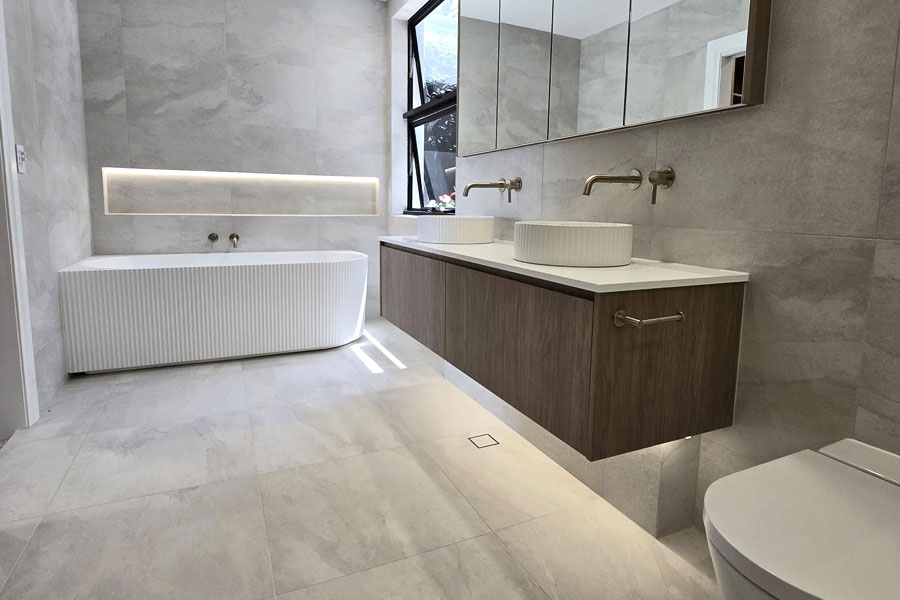
In this example, which is a more classical approach, the gloss white elements (bathtub, basins) have a high degree of contrast against the muted white tiles and especially the timber-style vanity. Notice how the back-lit LED mirrors light up the basins for visual impact. The great thing about gloss white in a bathroom situation is its versatility. It can go with similar, or different elements and easily build sustainable relationships with them.

Make the Most of Your Gloss White Fixtures

Gloss white is in most bathrooms and it makes sense to capitalise on this fact. Whether you’re going for a low, medium or high-contrast bathroom solution, you can leverage your gloss white fixtures to really make the most of the possibilities on offer.

Some Good Questions to Ask:

  1. Do I want my bathroom to be striking, or low key? A high-contrast result is more striking, and if you’re using gloss-white fixtures, this will mean pairing them with high-contrast fixtures.
  2. Do I want my bathroom to have subtle nuances? Investigate using textures that subtly contrast with your gloss white elements.
  3. How can I bring it all together? Think about how your bathroom elements are anchored in the room. Use colours and textures to position them so that they look as if they belong.
Book a Free Renovation Consultation & Quote

Filed Under: Renovation Design Tagged With: Bathroom Design, Bathroom Renovation, Colour Scheme, Gloss White, Renovation Design

Are Laminate Splashbacks a Good Bathroom Choice?

Armrock Constructions specialises in bathroom renovations on the Gold Coast. In any bathroom renovation, a number of important choices must be made about materials, inclusions and styles. In this article, we review the topic “Are Laminate Splashbacks a Good Bathroom Choice?”

Book a Free Renovation Consultation & Quote

What is a Bathroom Splashback?

A splashback goes on the wall directly behind a sink or wet area. It is a distinct section, designed to add a layer of protection against water splashing onto non-water resistant areas, and also has a role to play in the presentation of the room. In the following image, you can see the splashback on the wall beneath the lights, behind the vanity unit.

Bathroom Splashback

Splashbacks can be used in bathrooms, toilets, laundries and kitchens. Splashbacks can be made from different types of materials including tiles, acrylics, glasses, laminates, and other water resistant options. In this article, we’re looking into splashbacks made from laminates, and whether they are a good choice to use in a bathroom.

Do I Need a Bathroom Splashback?

While having a splashback isn’t essential, it is essential to protect your home from water. A splashback is not the only way of achieving this. A popular option in many of our Gold Coast bathroom renovation projects is to extend the wall tiling behind the vanity to provide a layer of water resistance and protection. This style is demonstrated in the following image:

Wall Tiled Splashback

This is just one of many possible ways to solving the problem of protecting your walls from water. Another example follows, where the mirror is extended down to the top of the vanity, ensuring water resistance is achieved:

Mirror as Splashback

While splashbacks aren’t the only way to solve the problem of water-resistance behind the vanity, they are a popular solution for this problem because of the design advantages that they can bring to a bathroom. When the decision is made to include a splashback, the next choice is the type of material to use. Are laminates a good option to use in a bathroom splashback?

Laminate Splashback Viability

Bathroom splashbacks need to be water-resistant, hard-wearing, long-lasting and easy to clean. A high-quality laminate splashback meets all of these criteria. Unlike kitchen splashbacks, where proximity to the heat of a stovetop may rule out a laminated solution, they are definitely a good option to consider in bathrooms.

In addition to these features, laminate splashbacks can also be custom-made by our team to suit your vanity unit, and come in at a favourable price point compared to other splashback options. This makes laminates a highly viable splashback option for bathroom renovations.

Laminate Splashback Benefits

There are heaps of advantages to using a bathroom splashback! Let’s check out some of the common ones, which can improve the functionality and look of your renovated Gold Coast bathroom.

Easy to Clean
A bathroom splashback is usually made of materials such as glass, acrylic or tiles that are easy to clean. They can be easily wiped down with a damp cloth to remove any water spots or stains.

Moisture resistance
Splashbacks are designed to be moisture-resistant, which makes them ideal for use in bathrooms where there is a lot of moisture. They can help prevent water damage to the wall behind the sink or vanity, which can be costly to repair.

Protection
A splashback protects the wall behind the sink or vanity from water damage, stains, and mold. This can help extend the life of your bathroom and prevent costly repairs.

Hygiene
A splashback can help prevent the growth of mold and bacteria in the bathroom, which can be harmful to your health. It can also help to maintain a clean and hygienic bathroom.

Design flexibility
Splashbacks are available in a range of materials, colors, and patterns, which makes them a versatile design feature. After all, with bathrooms, it’s all about style! Laminates represent the opportunity to incorporate a huge range of styles into your bathroom design. Check out some of the options available in the Nikpol range here. You can use them to simulate timber, stone, acrylic, or introduce patterns and dynamism into your design. Learn more about timber-look laminates here. Some laminate solutions also include texture, making their presence dimensional and truer to the original material that they are replicating.

Book a Free Renovation Consultation & Quote

Filed Under: Bathroom Renovation, Renovation Design Tagged With: Bathroom Renovations, Laminates, Splashback Options, Splashbacks, Timber Laminates, Vanities, Water-Resistance

Using Colour to Create a Holistic Bathroom Renovation

Choosing the colours in a bathroom renovation is one of the most exciting and challenging parts of any bathroom renovation project. Unless you have done 6 years of interior design study at university, you may rapidly learn that there is more involved in colour selection than meets the eye. Making important colour choices can mean the difference between an average and an outstanding bathroom outcome. In this article, we will use examples of our Gold Coast bathroom renovation projects to discuss winning strategies for colour selection in bathroom design, towards the goal of a creating a holistic home.

What is a Holistic Home?

Regardless of the interior style you’re into, having the goal of a holistic home is what this is all about. That means the bathroom works together with the rest of the home in a meaningful way – fitting in with the rest of the home. Whether your existing interior style is modern, vintage, relaxed, conservative, bohemian or high-end, it’s ideal for your newly renovated bathroom to fit in with the overall theme.

Holistic Definition: Dealing with or treating the whole of something or someone and not just a part [SRC: Cambridge Dictionary]

The Relationship Between The Bathroom and the Home

To create a holistic bathroom design, a great starting point is to remember to evaluate the rest of your home when you’re designing your bathroom. If you design your bathroom in isolation, it doesn’t stand much chance of successfully integrating because in a holistic home, relationships are everything! Some helpful things to look at are:

  1. List the colours used in the home.
  2. How colourful is the home?
  3. Is the home light or dark?
  4. Take a look at the colour and style of existing fittings such as handles & doorknobs.
  5. Describe the general theme in the home; e.g. modern, relaxed, minimal, natural
  6. Pay particular attention to the kitchen, laundry & toilets

These types of observations don’t need to explicitly guide our choices. But they do create awareness. We need to be aware that when we design the bathroom, the colours that we choose will have relationships with the existing style of the home, and these relationships can be optimised for a more holistic result.

Styling Beyond The Bones

A handy piece of knowledge that separates professional designers from everyone else is that less is more. All of the colours, shapes, textures and styles available in a bathroom renovation come in a bewildering array of options. An over-zealous approach can create a design that will tire very quickly.

A simpler and more conservative approach might sound boring, but bathrooms, like any other room in the home, can be styled beyond their bones. Accessories like pot plants, towels, artwork, and other items can also help your bathroom to integrate into the wider home, without compromising the bathroom with an over-zealous design approach. Read about What Colour Blinds go with White Walls for more styling ideas.

Approaching Your Bathroom Design

The safest approach to your bathroom design is to extend the home into the bathroom by utilising existing colour choices and styles to make the bathroom ‘more of the same’. It’s safe in the sense that, assuming you like the rest of the interior design, you will like the new bathroom, and it will fit in with the rest of the home.

However, being holistic doesn’t just mean being the same. It means that there is a relationship. The parts (rooms) of the home can be best understood as a whole (the whole home). While sameness is safe, most of the time, we want more from the opportunity of a bathroom renovation.

Bathroom renovations are a great chance to inject some of our own personality and stylistic intention into the home – to make it our own.

By keeping the rest of the home in mind when designing the bathroom, it’s possible to create a ‘safely creative’ design space, where design choices can be made that will help produce a holistic home: a home that is balanced between what the home is, and what you’d like it to be.


Winning Approaches to Bathroom Style

The following examples from our recent Gold Coast bathroom renovations demonstrate some winning approaches that can be adapted to suit a wide variety of bathrooms:

Complementary Colour Bathroom Style

Using two complementary colours in your bathroom creates a winning outcome that can be adapted to suit a wide range of bathrooms and homes. Here’s an example from a recent Gold Coast bathroom renovation, where we have used turquoise tiles and blonde timber-look laminate to create a punchy, energetic bathroom using natural tones.

Turquoise Blonde Custom Timber Laminate Vanity

The rest of the design falls into the safe zone with greys and whites, allowing the bathroom colours to effortless sit amongst the mid-tones for a light, fresh feeling.

Black & White: Low Contrast

Black and white are popular bathroom colours. This classical colour combination endures over time, and won’t tire as quickly as a brighter design may. In this black and white example, there is very little contrast (the bathroom is mainly white), with subtle black touches in the tapware, handles, grout-lines and tile-inset drains.

Colonial Bathroom Renovation

Black & White: High Contrast

This Gold Coast high-rise bathroom is another example of a black and white bathroom design, with a higher degree of contrast being realised by the black laminate bench-top. Immediately stronger in visual presence, this creates a sophisticated and high-end bathroom. Perfect for a penthouse!

Penthouse Bathroom Renovation

Juxtaposed Organic

This is a cool bathroom style. There’s more happening here than just the colours – shape and texture has a big role to play. In terms of colours though, the timber tones, brushed-brass tapware and mosaic tile splashback (and in fact, wall tiling) combine for a stylish meeting between organic and industrial ideas.

Gold Coast Bathroom Upgrades

White with Timber

Timber has such a great outcome in bathrooms. Paired with the simplicity of white walls, a timber vanity engages an organic vibe which is simultaneously modern and versatile. We use timber-look laminates to create great outcomes for our custom vanities, and sometimes a successful bathroom renovation doesn’t need anything more than this.

Gold Coast Bathroom Upgrades

Feature Wall Splash of Colour

This bathroom renovation carries on from our white/timber concept to the inclusion of a baby-blue tiled feature wall. Note how the grout-lines are sympathetic to the timber / brushed-brass tones in the bench top, tapware and fittings. This concept creates a sophisticated and whimsical result. Again, it is ultimately a simple recipe: white, timber, and a feature-colour in tiles of your choice.

Gold Coast Bathroom Renovations

Extravagant Splashes of Metallic Colour

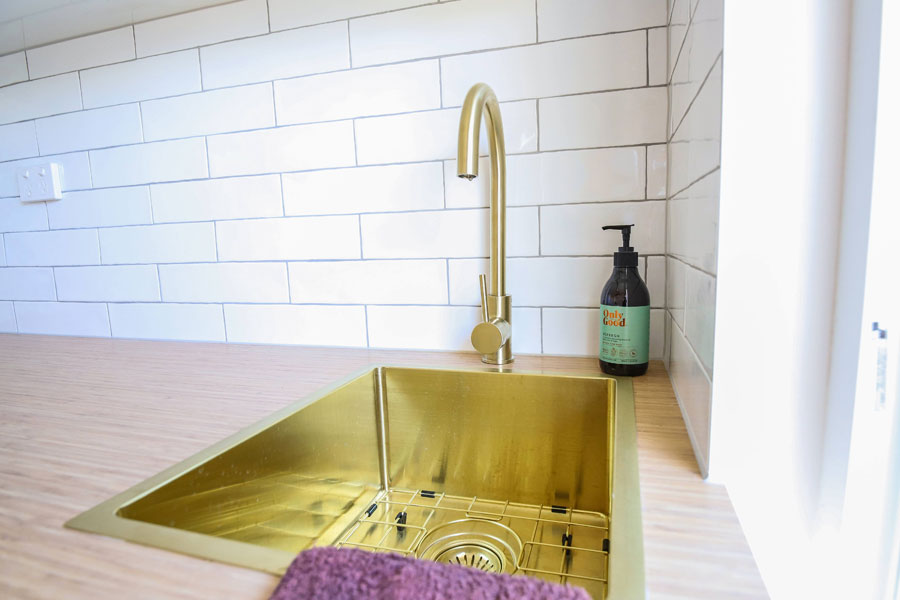
Typical bathroom metal colours are silver, black, and brushed brass. Surprising and interesting effects can be introduced by unexpected metallic inclusions. In this bathroom / laundry, an otherwise low-key approach (white tiles, timber-look laminate benchtop) gets a *surprise* addition of a brushed-brass tap and sink. It’s colourful, energetic, and adds some interest and excitement to the design, without overwhelming the room.

Laundry Tap & Sink
Laundry Tap & Sink

LED Lighting Excitement

Adding some LED lighting to your bathroom can be transformative. This simple black and white design gets a powerful punch when the purple LEDs are activated. What’s really cool is the versatility that this offers. You may not need it everyday, but when it’s party time, guest will be washing their hands in purple LED style!

Bathroom & Laundry Upgrades
LED Lighting in Bathrooms
Book a Free Renovation Consultation & Quote

Filed Under: Renovation Design Tagged With: Black and White, Colour, Colour Scheme, Contrast, Design Strategy, Holistic Design, Timber and White

Round Mirrors in Bathroom Design

Round mirrors are a popular bathroom design feature that are included in many of our Gold Coast bathroom renovation projects. If you’re trying to decide whether to include a round mirror in your bathroom design, this page will be a useful resource for you, and features examples from our recent Gold Coast bathroom renovation projects.

Book a Free Renovation Consultation & Quote

Connecting with Round Mirrors

A major advantage of round mirrors is the way they integrate bathroom elements without dominating the design. Round mirrors may not fill the whole space, but they feel like the do, and this enables them to not only connect bathroom elements, but do so in a lovely way.

In the following image, you can see a colonial-themed bathroom renovation undertaken by our team. Note that the vanity and window are similar in shape (rectangular) and size. We’ve used a double-round mirror here which helps to connect these two elements. Imagine a square, or rectangular mirror in this scenario.. it may overwhelm the room, whereas the round mirrors create a sense of connection and integration.

Double Circular Mirror Integration

Concentrated Design Focus

In the following image, from the same renovation project (it involved a double-bathroom renovation) we’ve used a singular round mirror above the vanity unit. This creates an interesting focus for the bathroom which wouldn’t exist if a larger or more dominant mirror were utilised. Because this colonial bathroom renovation requires the harmonious juxtaposition of multiple irregular objects, the round mirror provides a way to connect, integrate, and relate the room.

Single Circular Mirror Integration

Bathroom Flow & Circular Mirrors

A goal of bathroom design is always to make rooms that make sense. A sense of flow, or movement, through the bathroom elements can help to accomplish this. One of the great attributes of round mirrors is how they enable rooms to flow. Even in rooms with a static feel, a round mirror enlivens and rejuvenates the space, making it feel larger and more dynamic. Interestingly, on the majestic glass.com.au website, they note “if you are planning to redecorate your beloved bathroom, or just want to spice up the design, then the best and easiest thing to do is replacing the current dull mirror with a round one”.

Cultivating Visual Interest

Single Circular Mirror Integration

Round mirrors are a fantastic way to cultivate visual interest. The dynamic nature of the circle ensures the eye will always have somewhere to go. A round mirror activates and cultivates this sense of dynamism, which event by its solitary contribution can help take your bathroom to the next level. This particular bathroom also includes a built-in shower, which is a great option to consider for your renovation as well.

Anchoring the Vanity

Anchoring the Vanity with a Mirror

A bathroom vanity is the cornerstone of any bathroom. Utilising a custom vanity in your bathroom renovation is a great way to express and integrate your bathroom design. A challenge of working with vanity units is the difference of their shape within the bathroom. Low and horizontal, they can contrast poorly with taller elements such as the shower or the bathroom door. Because vanity units are always paired with a mirror, this deficiency is overcome; in the case of round mirrors, vanity units can achieve a vertical presence albeit at a much smaller footprint of bathroom real estate.

This effect is also demonstrated in the following images from a recent Gold Coast bathroom renovation below. Note how the circular mirror helps connect the vanity with the room, and creates a visual bridge between the vanity and the shower. Read about this project here.

By the way, isn’t the tiling in these projects fantastic! Learn more about tiling with our team here.

Anchored Vanity
Bathroom Integrity

Making Important Choices

Anchoring the Vanity with a Mirror

A round mirror isn’t always the best choice, and definitely not the only choice. It’s just a great option to keep in mind instead of defaulting to a rectangular or square mirror. Talk to our team about your Gold Coast bathroom renovation. We look forward to working together with you to create your ideal bathroom design, and then helping you to bring it to reality.

Book a Free Renovation Consultation & Quote

Filed Under: Renovation Design Tagged With: Bathroom Design, Bathroom Flow, Mirror, Round Mirror

  • « Go to Previous Page
  • Page 1
  • Page 2
  • Page 3
  • Page 4
  • Page 5
  • Go to Next Page »

Primary Sidebar

Graham Robertson

Roland renovated both the Ensuite & main bathroom, removing the walls around separate toilets which increased the overall spaces. The team of guys who did the demolition & construction were really easy to deal with & the finish is excellent. It was no problem for us to request minor changes along the way. We’re really pleased with the outcome & would thoroughly recommend.

Matt Lyons

Attention to detail. Great finish. Highly recommend these guys!


Keith Munday

Very pleased with a very professional job completed by Roland and his team. Roland never failed to turn up when expected or respond to a message if he was unable to take a call. He was also helpful and patient while we changed our minds repeatedly about what we wanted. We’re getting him back to do the kids bathroom!


Terry Christo

We had the pleasure of dealing with Roland and his team. They are professional courteous clean and most importantly excellent communicators during the process. Their workmanship and pride in achieving an excellent result is a breath of fresh air when dealing with trades people. I highly recommend them.

Richard Anyos

Good, friendly, prompt, reliable service with attention to detail.

Cameron Grant Ruksenas

Great service from the owner Roland. Nothing was a problem and service and price was reasonable! Will recommend to others.


Andrew Watkins

Roland and his team were very professional and affordable. We had two bathrooms and a laundry renovated by Armrock Constructions and we couldn’t be happier. Would definitely recommend them.

Lucy Fisher

Great communication, good attention to detail. We were so impressed. Our new ensuite looks amazing!


Renovation Testimonial

From quote to completion, Armrock was outstanding. We couldn’t be happier. Hassle free and on budget. If you’re after attention to detail you’ve come to the right place. Highly recommended. Thanks again.


Reiner Ebenhoch

Armrock Constructions did our powder room first. We were so impressed with their work that we contracted Armrock to do a minor reno to our master bathroom and a major renovation of our guest bath room, which also included the complete rebuilt and conversion of one room into a steam room. Again, Armrock did an excellent job! What sets Roland and his team apart is their customer focus, their uncompromising attitude to quality, integrity and customer satisfaction. We can recommend Roland and his team unconditionally and have so already to many of our friends!

Al Dobie

Roland and his team were fantastic. The work was done on time and of a very high standard. Cheers Roland.

Geoff Haigh

Excellent workmanship. Professional, on time. Easy to deal with.

Cameron

Roland from Armrock constructions has completed a few projects for our company and is always a pleasure to deal with. Always reliable, not like some tradies we have chosen in the past. Quality is something Roland strives for and it shows in his work. Would recommend to anyone.


Joel Boniwell

The moment I contacted the owner Roland I was at ease with proceeding with this company. Not only does he come across as a genuine person, he is punctual and sticks to his word. He had everything organised and the renovation of my en-suite went exactly as planned and the quote was spot on. The tradesman he organised for the job are all extremely punctual and extremely qualified at their specific trades. I can’t give this company a stronger recommendation and will be sure to use Roland and his team for any future renovations. A+ Service in an industry that you will seldom find it in.

Small Reno Testimonial

I don’t often write reviews but felt this time I had too. A huge thank you to Roland from Armrock constructions. From the first time I contacted Roland he could not have been more helpful and professional. Roland was on time, got the job done and left my home clean and tidy. Please if your wanting a small spruce up or a full reno done these are the people to call. Thanks once again Armrock.

Shayna Kivlins

Highly recommend your company to anyone wanting an amazing and highly professional job done your attention to detail with our kitchen was 120% you were very helpful in all aspects from start to finish and the end product exceeded my expectations. You are a very talented guy and I can’t thank you, Luke the sparkie and Chris the plumber enough for making my kitchen dream come to life.


Mark & Di Branks

Roland delivered an exceptional product. Our Bathroom upgrade was completed on time and to budget. As with most renovations there were a number of unforeseen issues and Rolands ability to offer practical, cost effective solutions was exceptional. A very professional, clean and tidy builder and we have no hesitation in recommending his services.

Renovation Links

  • Gold Coast Bathroom Renovation Specialists
  • Renovation Services
  • Bathroom Renovation Projects
  • Testimonials

Tags

Bathroom Design Bathroom Layout Bathroom Renovation Bathroom Renovations Bathroom Style Bathroom Tiling Bathroom Vanity Black and White Bathroom Circular Basin Colour Custom Vanity Dividing Wall Double Shower Gloss Gold Coast Gold Coast Bathroom Renovations Gold Coast Custom Vanity Gold Coast Renovations Gold Coast Renovation Trades In-Wall Cistern Interior Design Layout Change LED Lights Louvres Matte Medium Contrast Merrimac Bathroom Renovations Mirrored Wall Cabinet Mounted Basin Mounted Basins Plumbing Polished Brass Reno Trades Renovations Renovation Team Round Mirror Shower Shower Screen Installation Sink Tiled Bathroom Niches Tile Insert Strip Drain Tiling Timber-Look Laminates Timber Laminate Timber Laminates

Footer

Handy Links

  • Bathroom Renovation
  • Bathroom Renovation Gallery
  • Armrock Services

Free Appraisal & Quote

Our service starts with a free appraisal and quote. Organise an appointment with Armrock Constructions to get your renovation moving in the right direction today.

Armrock Constructions

Hours
We operate Mon-Fri, 8-5pm

Service Area
We service the Gold Coast area.

QBCC Licence
15078854

Copyright © 2026 · Armrock Constructions